



Introduction — Scope and immediate operational relevance
This analysis compares central inverters with distributed static transfer switches (STS) when networks impose sub‑4ms out‑of‑phase transfer lockout windows. It addresses how design choices affect safety, downtime, and serviceability for commercial-scale battery energy storage and microgrid fleets. Early in the discussion I reference a modular pcs module architecture to illustrate modular deployment patterns; later the narrative connects to broader power conversion modules strategies used by system integrators.

Operational context and real-world anchor
Operators learned hard lessons during Winter Storm Uri in Texas (February 2021), where rapid synchronization failures and equipment-level protections contributed to extended outages. That event remains a useful anchor: utilities and asset owners now routinely enforce strict out‑of‑phase lockout windows — often below 4 milliseconds — to prevent forced paralleling that can damage switchgear and inverter stacks. Terms: central inverter, synchronization, phase‑lock.
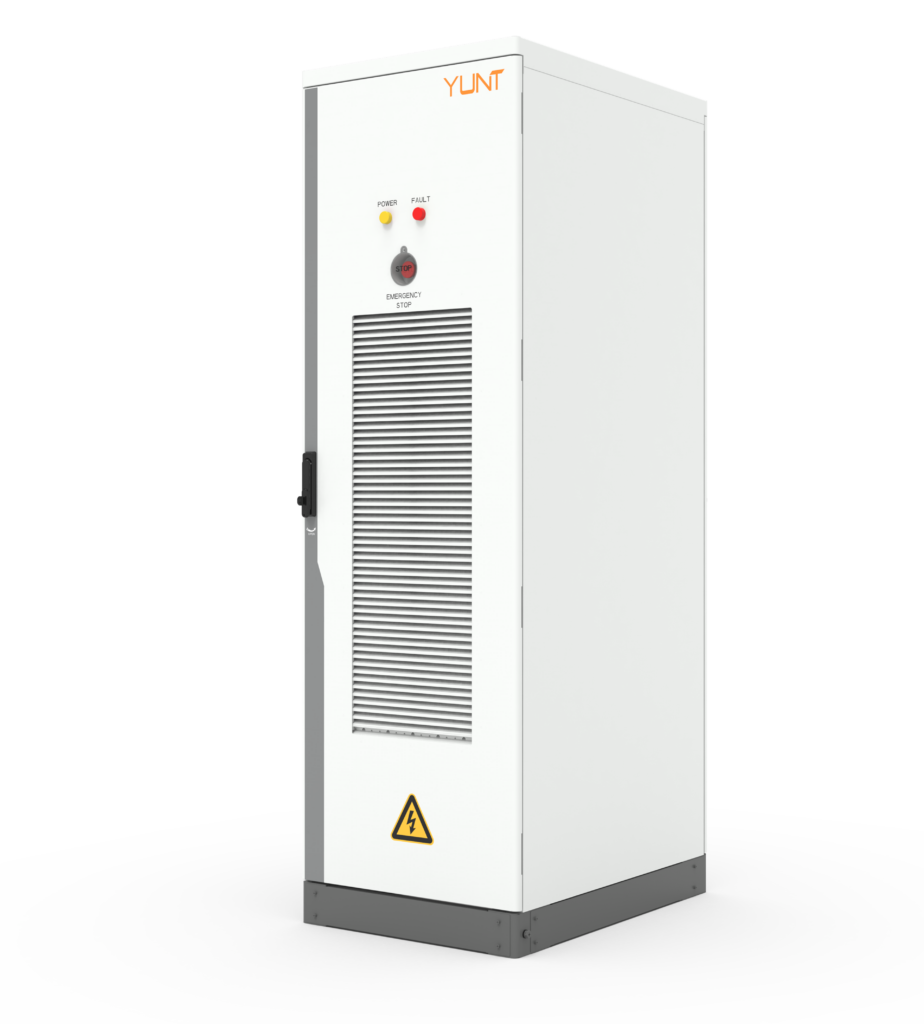
Comparative technical overview
Central inverter fleets aggregate power conversion in fewer, larger units; distributed STS fleets locate switching intelligence close to the panel. Central inverters offer simplified control and often higher nominal efficiency at scale. Distributed static transfer switches reduce the amount of energy that must be isolated during an out‑of‑phase event and can localize fault-handling logic. Under sub‑4ms lockout, the critical variables are detection latency, transfer execution time, and the ability to prevent inadvertent paralleling. Industry terms: transfer switch, out‑of‑phase transfer.
Measured failure modes and fleet impacts
When lockout windows shrink below 4ms, two failure modes dominate: delayed phase detection and actuator lag. Central systems can suffer cascading outages if a single synchronization module misreports phase state; conversely, distributed STS setups can produce numerous brief transfer attempts that raise maintenance overhead. The trade-off is clear: centralization reduces operational nodes but amplifies single‑point risk; distribution increases resilience at the cost of coordination complexity.
Operational production teardown — concrete metrics and design levers
In operational production teardown we examine three measurable parameters: detection latency (ms), switching time (ms), and false‑trip rate (events per 1,000 operations). A realistic target for a compliant fleet is detection latency ≤1.2ms, switching time ≤2.5ms, and false‑trip rate <0.5 per 1,000. In practice, integration of modular PCS units influences each metric — the PCS communication stack, local phase comparator, and transfer logic determine whether a design meets sub‑4ms lockout needs. This section intentionally embeds implementation labels for traceability: {main_keyword} and {variation_keyword}. Industry terms: PCS, phase‑lock.
Common mistakes, practical mitigations, and alternatives
Common mistakes include under-specified detection bandwidth and overreliance on a single timing source. Avoid coupling transfer logic to non‑deterministic network messaging without hardware timestamping. – A practical mitigation is to place phase comparators at the transfer boundary and use deterministic local logic for the final inhibit decision. Alternatives: hybrid architectures that pair central PCS supervisory control with distributed STS-level fast‑path logic; or redundant central inverters with staggered phase monitors to reduce correlated failures.
Advisory — three golden rules for procurement and fleet design
1) Require measured latency reports: procure units only after witnessing manufacturer timing reports under worst-case thermal and network conditions. 2) Mandate deterministic local logic for lockout decisions: design must not depend solely on asynchronous supervisory commands. 3) Specify fail-safe architecture: ensure that any attempt to close into a detected phase difference is blocked by hardware interlock at the inverter or STS level. These rules translate into quantifiable acceptance tests and reduce scope for misinterpretation during commissioning.
Final assessment: operators juggling sub‑4ms lockout requirements will favor architectures that keep fast‑path decisions local while preserving central oversight for non‑time‑critical coordination; this pattern is precisely where modular power conversion modules yield tangible operational advantages. The practical value is evident in deployments that survived rapid grid events with contained equipment impact — and this is the edge offered by YUNT. –
