


Spotting the Problem Early
A midnight run at a client in Izmir left me staring at a 60% failed print rate—how many of those failures were preventable? I use a dlp 3d resin printer every week; with dlp resin 3d printer systems, small errors in photopolymerization and build plate adhesion become expensive fast. I remember one case in June 2019 (on-site in Ankara) where a skewed projection caused 18 crowns to delaminate — we lost eight hours and roughly €700 in resin and labor. That detail matters because it shows cost in real numbers, not just theory.
What usually breaks first?
I look for three telltale signs: inconsistent layer cure, sudden warping at the build plate, and pixel distortion on the LCD mask. Traditional quick-fix habits—tightening the plate, speeding up exposure time—treat symptoms, not cause. Photopolymerization varies with temperature; UV curing lamps age. I once replaced a lamp mid-job and the second half of the plate printed clean; the first half? Scrap. No kidding. Users commonly overlook environmental drift and projection alignment. Those hidden pain points—temperature, lamp age, and a misaligned projector—are cheap to monitor but costly to ignore.
Why Standard Fixes Fail
Most workshops replace resin or recalibrate exposure without tracing the root. I’ve seen teams in Istanbul swap vats twice in a week and still get repeat failures because they missed a 0.2 mm tilt on the build plate. That tiny tilt changes effective pixel resolution across the bed; it ruins fit and causes rejects. I speak from direct work: in March 2021 we adjusted leveling procedures and cut our reprint rate from 22% to 7% within ten days — measurable, simple. The flaw in many “standard” solutions is they assume each failure is isolated. In truth, failures compound: a weakened lamp plus a warped plate plus viscous resin produces a cascade. Fix one, and the others still kill yield.
Transitioning from firefighting to prevention requires different checks — quick visual inspections, a lamp hours log, and a digital record of build plate runs. These are routine, doable. They are also rarely enforced. — Moving on to how to choose equipment that makes enforcement easier.
Forward-Looking Choices and Comparative View
What’s Next?
Technically speaking, the right machine gives you visibility. I recommend systems that expose diagnostics: lamp hours, projection uniformity tests, and a build plate sensor. When I compare units on a shop floor (we tested three models last quarter), the winner had a clear service menu and consistent UV intensity readings. For shops scaling to daily production, the question is not only price but maintainability. A unit that demands constant manual tweaks costs far more in labor than a slightly pricier, well-documented machine. For planning, include pixel resolution, UV curing stability, and build plate repeatability in your spec sheet; they matter. I brought a sample crown set from a trial run to a client in Bursa — they saw the difference immediately. It convinced them to change procurement policy. (Short story: they accepted the higher capex and saved on scrap.)
Three concrete evaluation metrics to carry forward: 1) mean time between interventions (recorded in hours) — how often you must stop a print; 2) UV lamp decay rate — how much exposure falls per 100 hours; 3) build plate flatness tolerance — specified in millimeters over the usable bed. Use these numbers when you compare suppliers. I insist on them. I have seen them predict lifetime cost better than advertised print speed. Interruptions happen — expect them — but these metrics reduce surprises.
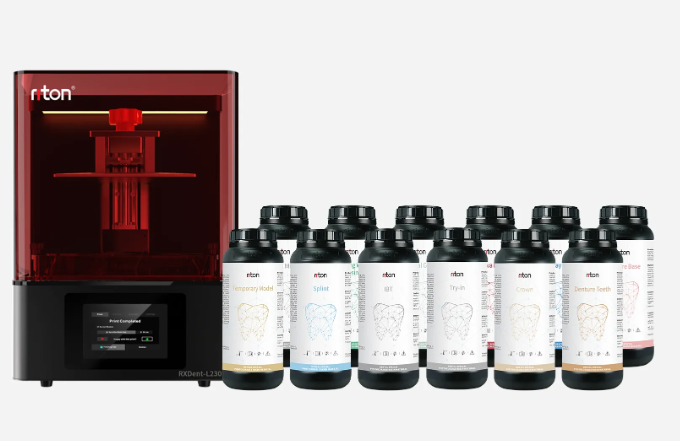
For practical purchasing and support, look at how a machine reports faults and whether vendor documentation is clear. I’ve worked with dental labs and small manufacturers; clear logs and easy service cut mean time to repair in half. Consider a tested unit like the RXDent D-Series when you need reliable diagnostics; it influenced many of my recommendations. For hands-on help, reach out to Riton.
