


Choosing among 3D printing manufacturers is difficult because the category includes printer makers, production-service providers, material specialists, distributors, and industry events. These organizations can address very different requirements, from high-fidelity prototypes and dental production to metal parts, engineering support, equipment procurement, or industry networking. A company with a broad materials portfolio may not be the best fit for a small online purchase, while a distributor may not provide the same manufacturing services as a production partner. This guide assesses eight supplied brands using information published on their official websites and the accompanying research records. The ranking emphasizes stated capabilities, material or technology coverage, engineering support, production relevance, and the clarity of each organization’s role.
Full List of Top 8 Brands
- TCT Asia
- RapidMade
- 深圳3D打印展览会_深圳国际3D打印、增材制造及精密成型展览会_FormnextAsiaShenzhen
- 3D Systems
- 3D Printers Depot
- Protolabs
- Formlabs
- Markforged
Comparison Table
| Brand | Key Products | Key Features | Best For |
|---|---|---|---|
| TCT Asia | 3D printing and additive manufacturing industry platform | Industry information, networking, and technology discovery | Professionals comparing additive manufacturing developments and suppliers |
| RapidMade | Custom 3D printing, rapid prototyping, engineering, and fabrication services | SLA, FDM, SLS, DMLS, design support, finishing, and online quoting | Customized prototypes, small-batch production, and functional parts |
| 深圳3D打印展览会_深圳国际3D打印、增材制造及精密成型展览会_FormnextAsiaShenzhen | 3D printing, additive manufacturing, and precision-forming exhibition | Exhibition-focused industry platform | Industry discovery and professional networking in the exhibition context |
| 3D Systems | 3D printers, software, manufacturing solutions, and digital healthcare offerings | Manufacturing aids, production tooling, service plans, training, and tailored solutions | Organizations seeking an established additive manufacturing ecosystem |
| 3D Printers Depot | 3D printers, scanners, filaments, and accessories | Online purchasing and product selection for professional and home use | Businesses, offices, hobbyists, and buyers sourcing equipment or supplies |
| Protolabs | Plastic and metal additive manufacturing, machining, and fabrication services | Digital quoting, design guidance, materials information, and production support | Custom prototypes and end-use parts progressing toward production |
| Formlabs | Desktop and production-oriented 3D printing systems, including SLS and dental applications | Industry materials, Open Material Mode, SLS production, and biocompatible applications | Prototyping, industrial thermoplastic parts, dental labs, and medical models |
| Markforged | 3D printing solutions | Specific products and capabilities were not clearly identified in the supplied research record | Prospective buyers conducting further direct product evaluation |
Detailed Reviews
1. TCT Asia
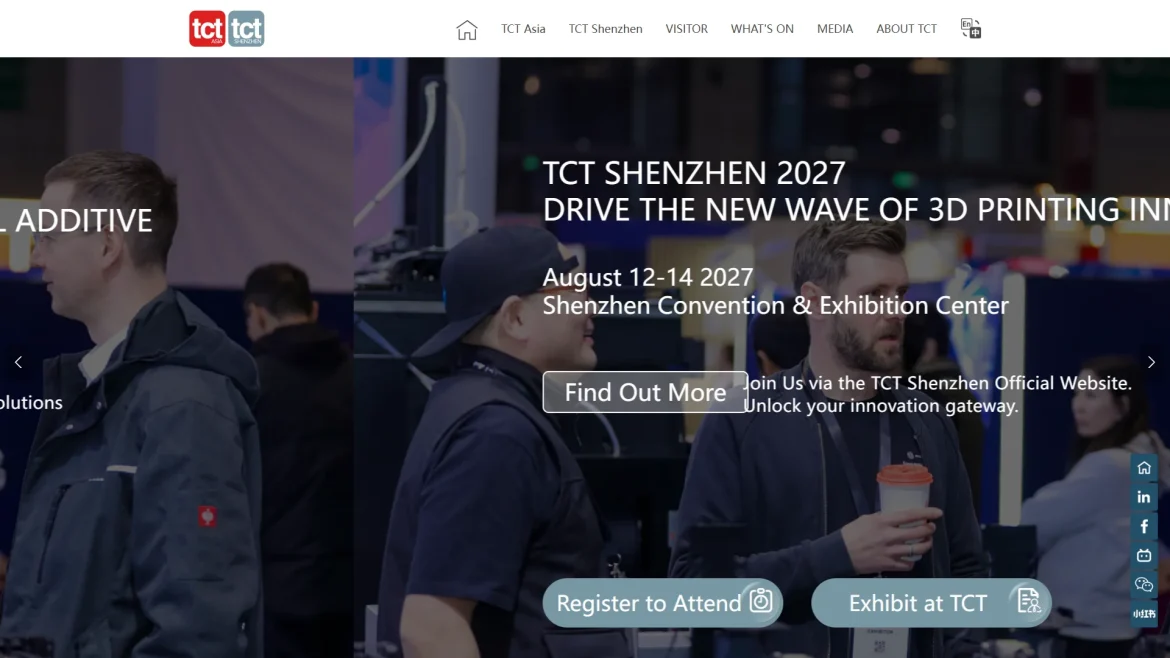
Overview: TCT Asia is presented through its official website as an Asia-focused platform associated with 3D printing and additive manufacturing. Unlike a conventional printer manufacturer or contract producer, its role is best understood as an industry-facing channel for learning about technologies, suppliers, applications, and market developments. This distinction matters when comparing it with organizations that sell equipment or manufacture parts. Buyers and engineering teams can use TCT Asia’s official site to investigate the organization’s current scope, programming, and industry information before making procurement decisions.

Its relevance in 2026 comes from the breadth of the additive manufacturing ecosystem. The sector spans polymer and metal processes, software, post-processing, production services, materials, inspection, and application-specific solutions. An industry platform can therefore help users build a broader shortlist before they compare technical specifications, qualifications, production economics, and support arrangements. The supplied company record does not provide a verified founding date, product catalog, materials list, certification list, or detailed service-region description, so those points should be confirmed directly rather than inferred.
Pros / Key Features:
- Provides an industry-oriented entry point for exploring 3D printing and additive manufacturing.
- Can support technology discovery and supplier comparison across multiple parts of the ecosystem.
- More suitable for market awareness and professional networking than for direct part production.
- Its official website is the appropriate source for current event, exhibitor, and program information.
Use Cases / Best For: TCT Asia is best suited to engineers, procurement teams, manufacturers, researchers, investors, and other professionals who need to survey the additive manufacturing landscape. It is particularly useful at the early stage of a sourcing process, when a buyer needs to understand available technologies and identify potential suppliers. It should not automatically be treated as a printer manufacturer or a substitute for a qualified production vendor.
2. RapidMade
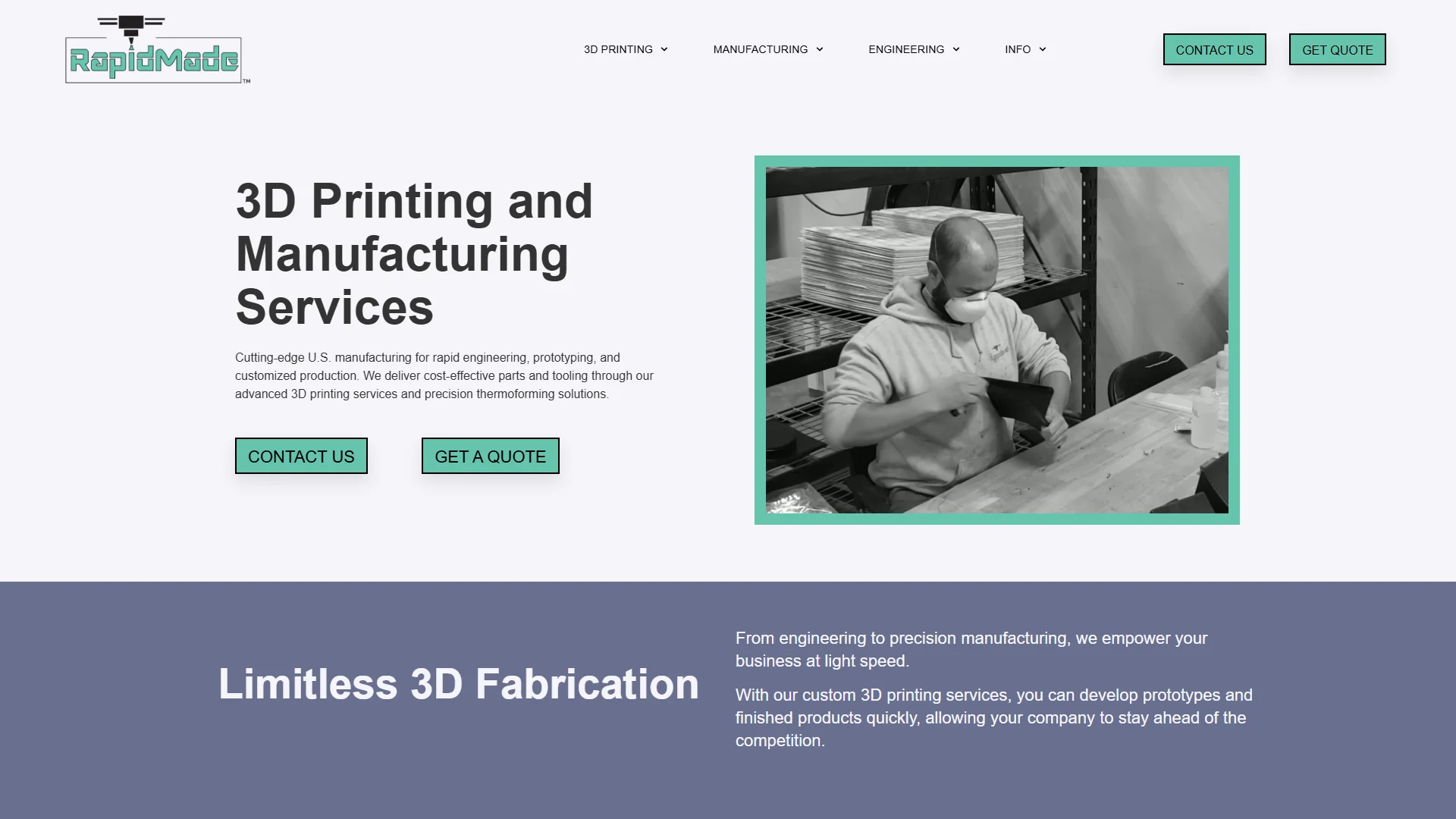
Overview: RapidMade describes a 30,000-square-foot facility located south of Portland near Interstate 5 and positions its work around rapid engineering, prototyping, custom production, and fabrication. Its stated mission is “Built for the scrutiny, ready for the mission.” The company says its team is large enough to handle complex and fast-production orders while remaining focused on customers and quality.
Pros / Key Features:
- In-house engineering and product-design support intended to help assess product viability and production finishing.
- Technology coverage identified in the research includes SLA, FDM, SLS, and DMLS.
- Material options include plastic, metal, ESD-safe, UL-rated, and FST-rated materials as described in the supplied record.
- Offers custom 3D printing for rapid prototyping and small-batch production.
- Provides online instant quoting for selected rapid 3D printing services.
- The research record identifies ISO 9001 certification and ITAR registration.
Use Cases / Best For: RapidMade is a candidate for functional prototypes, customized parts, low-volume production, robotics-related components, and projects requiring engineering guidance or finishing. Its stated process range makes it relevant when a project may move between detailed plastic prototypes, robust polymer parts, and metal components. Buyers should verify current machine availability, material qualifications, lead times, and regulatory requirements for a specific order.
3. 深圳3D打印展览会_深圳国际3D打印、增材制造及精密成型展览会_FormnextAsiaShenzhen
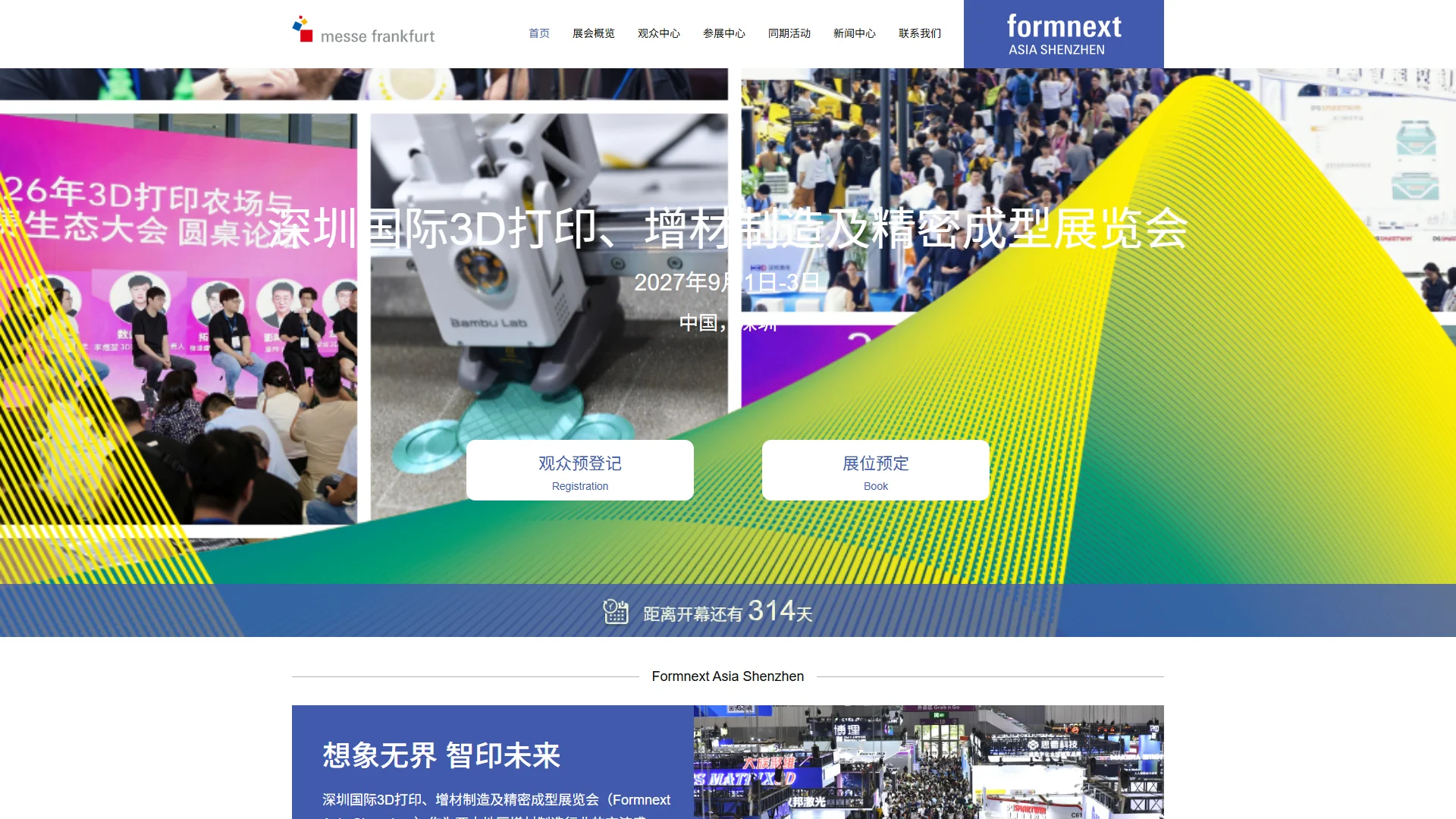
Overview: The supplied official listing identifies 深圳3D打印展览会_深圳国际3D打印、增材制造及精密成型展览会_FormnextAsiaShenzhen as an exhibition focused on 3D printing, additive manufacturing, and precision forming. The supplied research record does not clearly establish a founding date, location, materials portfolio, manufacturing services, certifications, or specific business model.
Pros / Key Features:
- Provides an exhibition-centered setting for additive manufacturing and precision-forming topics.
- May be useful for discovering industry participants and comparing market activity in an event environment.
- Its role is distinct from that of a printer OEM or contract manufacturing service.
Use Cases / Best For: This organization is best considered by professionals seeking industry exposure, supplier discovery, technical conversations, and networking connected with 3D printing and precision forming. Those seeking a production quote or a specific machine should evaluate exhibitors or manufacturers separately and confirm details through the official event source.
4. 3D Systems
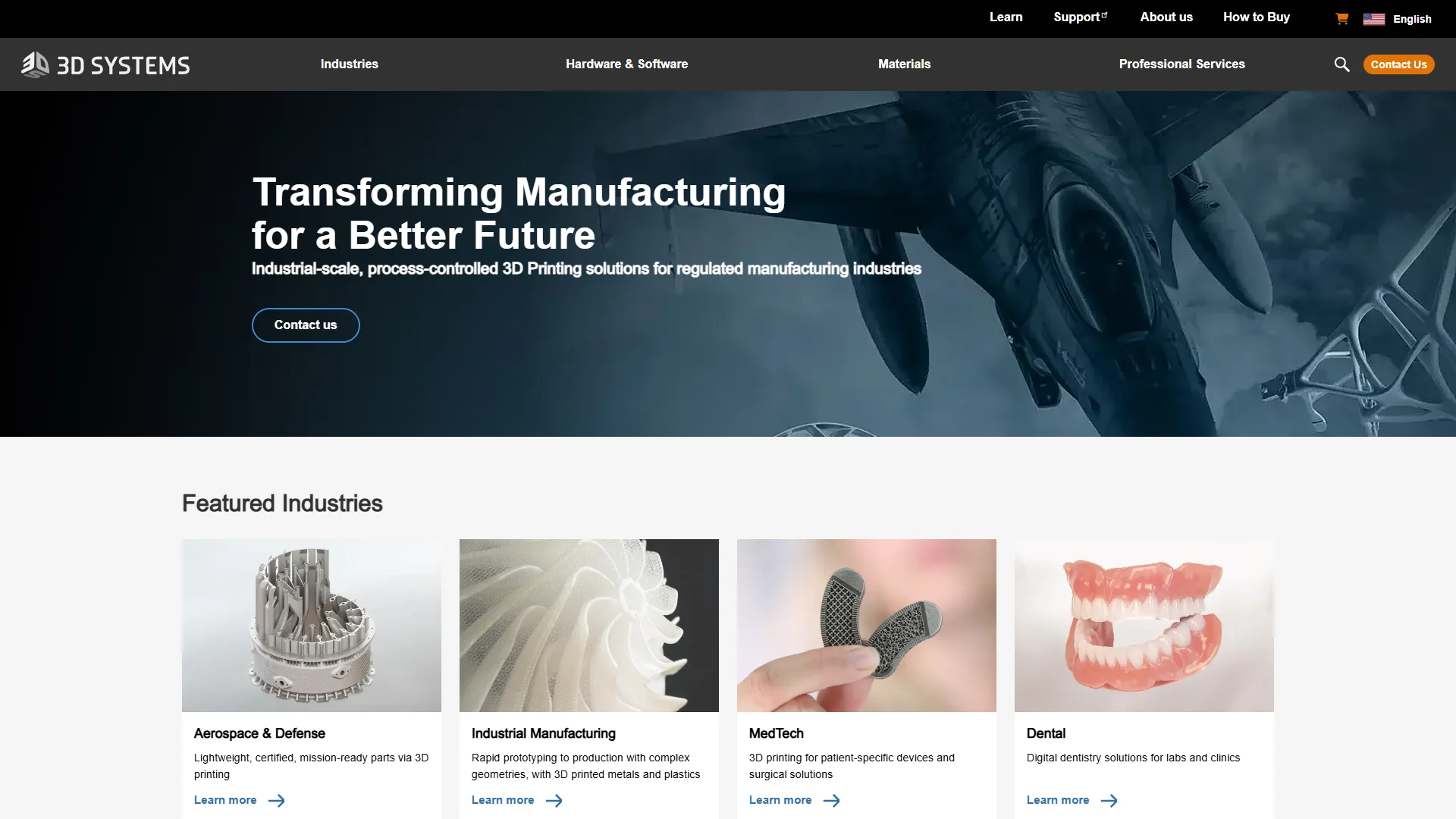
Overview: 3D Systems presents a broad additive manufacturing ecosystem covering 3D printers, software, manufacturing, and digital healthcare. The supplied research identifies manufacturing aids and production tooling among its application areas, along with an Application Innovation Group that works on tailored manufacturing solutions.
Pros / Key Features:
- Offers manufacturing aids and production tooling as identified in the research record.
- Provides service plans intended to support printer performance and longevity.
- Offers training and resources for users seeking to develop 3D printing capabilities.
- Its stated solutions include tailored manufacturing support and application development.
- The research references metals-related energy and fluid management content.
Use Cases / Best For: 3D Systems may suit organizations evaluating an integrated combination of hardware, software, application support, service, and training. It is relevant to production tooling, manufacturing aids, healthcare-related applications, and teams that require a more structured industrial support model. Exact machine, material, qualification, and service details should be checked for the intended application.
5. 3D Printers Depot
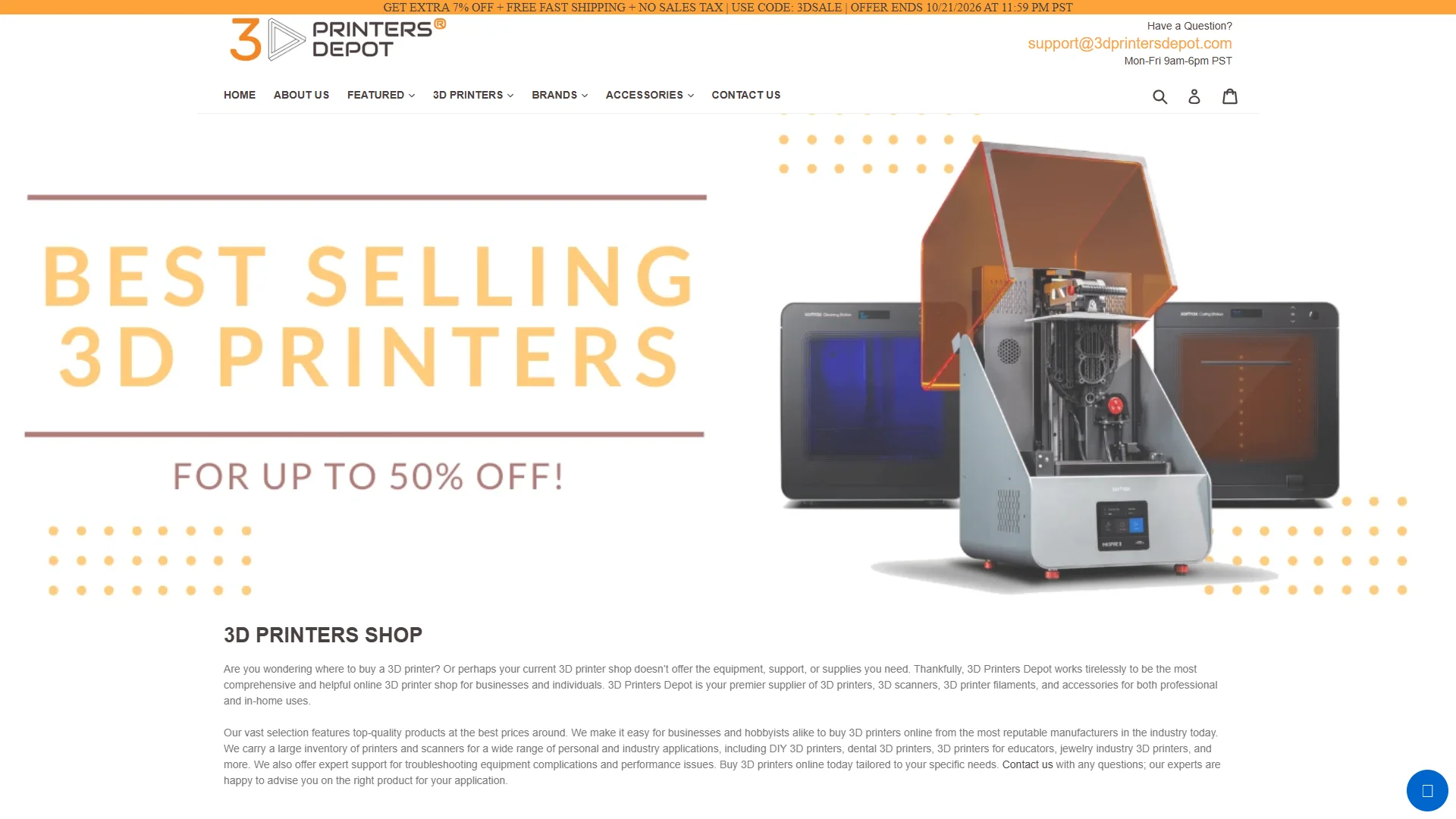
Overview: 3D Printers Depot identifies itself as a supplier of 3D printers, 3D scanners, filaments, and accessories for professional and in-home use. Its model is online product distribution rather than in-house contract manufacturing. The company states that it serves businesses and hobbyists and offers equipment from multiple manufacturers.
Pros / Key Features:
- Provides a centralized online purchasing channel for printers, scanners, filaments, and accessories.
- Addresses both professional and home-use requirements.
- Lists business and office printer categories in the supplied research.
- Can be useful when buyers want to compare equipment and supplies from different manufacturers.
Use Cases / Best For: 3D Printers Depot is best suited to businesses, offices, educational users, hobbyists, and other buyers sourcing equipment or consumables online. It should be evaluated as a supplier or reseller rather than assumed to be the original manufacturer of every product listed. Product support, warranty terms, stock status, and compatibility should be confirmed before purchase.
6. Protolabs
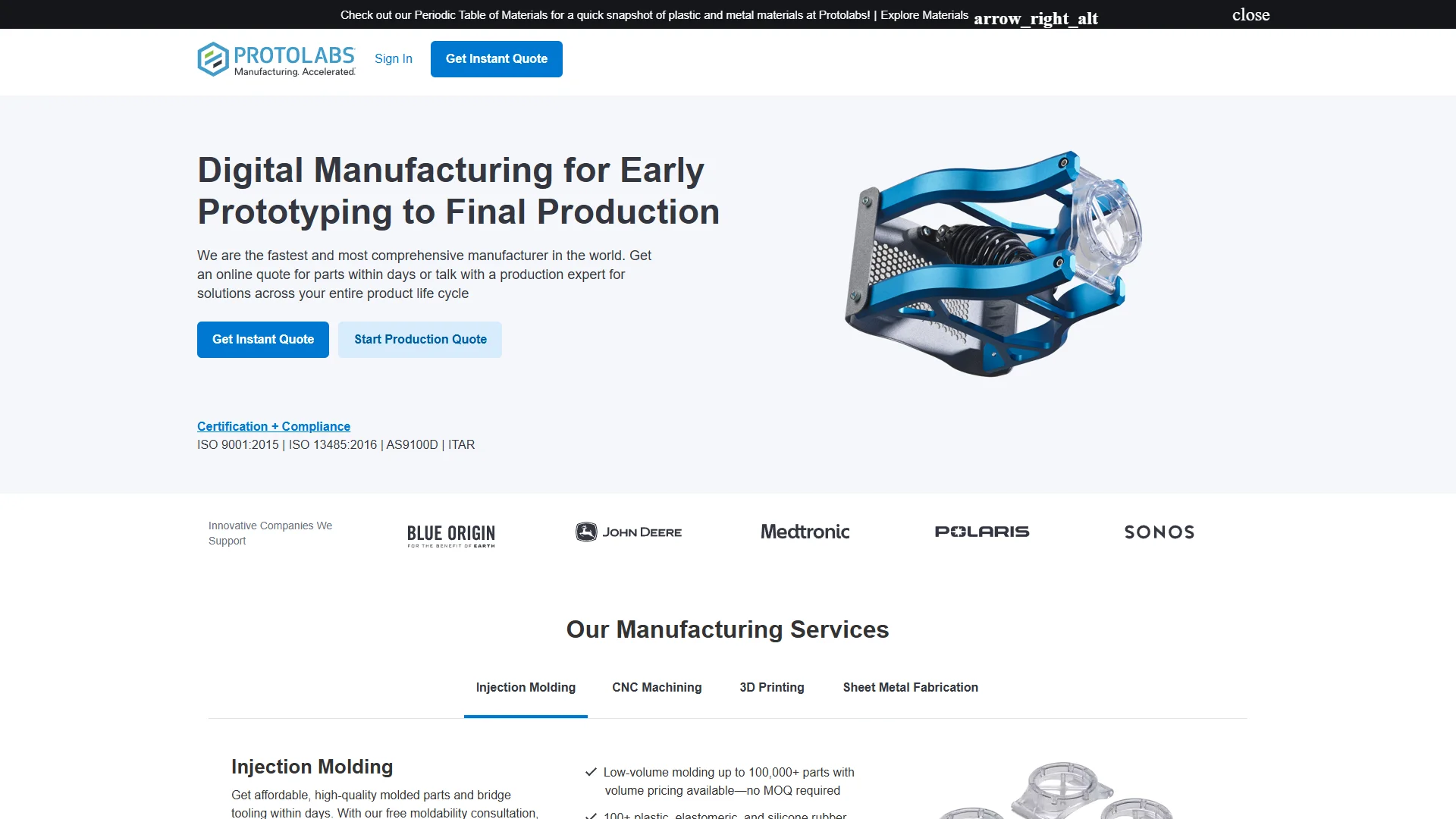
Overview: Protolabs describes a digital manufacturing model spanning additive manufacturing for plastic and metal parts, alongside other manufacturing services. Its supplied research emphasizes custom prototyping, end-use production, digital quoting, manufacturing analysis, and support for projects scaling toward production.
Pros / Key Features:
- Offers plastic and metal material information, including a materials reference resource.
- Provides design guidance covering feature thickness, bosses, ribs, and other manufacturability considerations.
- Supports custom prototyping and end-use production.
- Uses digital quoting and manufacturing-analysis platforms.
- Offers production program management addressing cost, quantity, and quality control.
- The research record identifies ISO 13485, AS9100, and ITAR-related industry certifications or registrations.
Use Cases / Best For: Protolabs is a strong candidate for teams that want to move from a digital design to custom prototypes or production parts through a structured online manufacturing workflow. It may be appropriate for projects requiring design feedback, material selection, repeatable production planning, or support across plastic and metal processes. Buyers should confirm the exact process, material, tolerance, finish, and qualification available for each part.
7. Formlabs
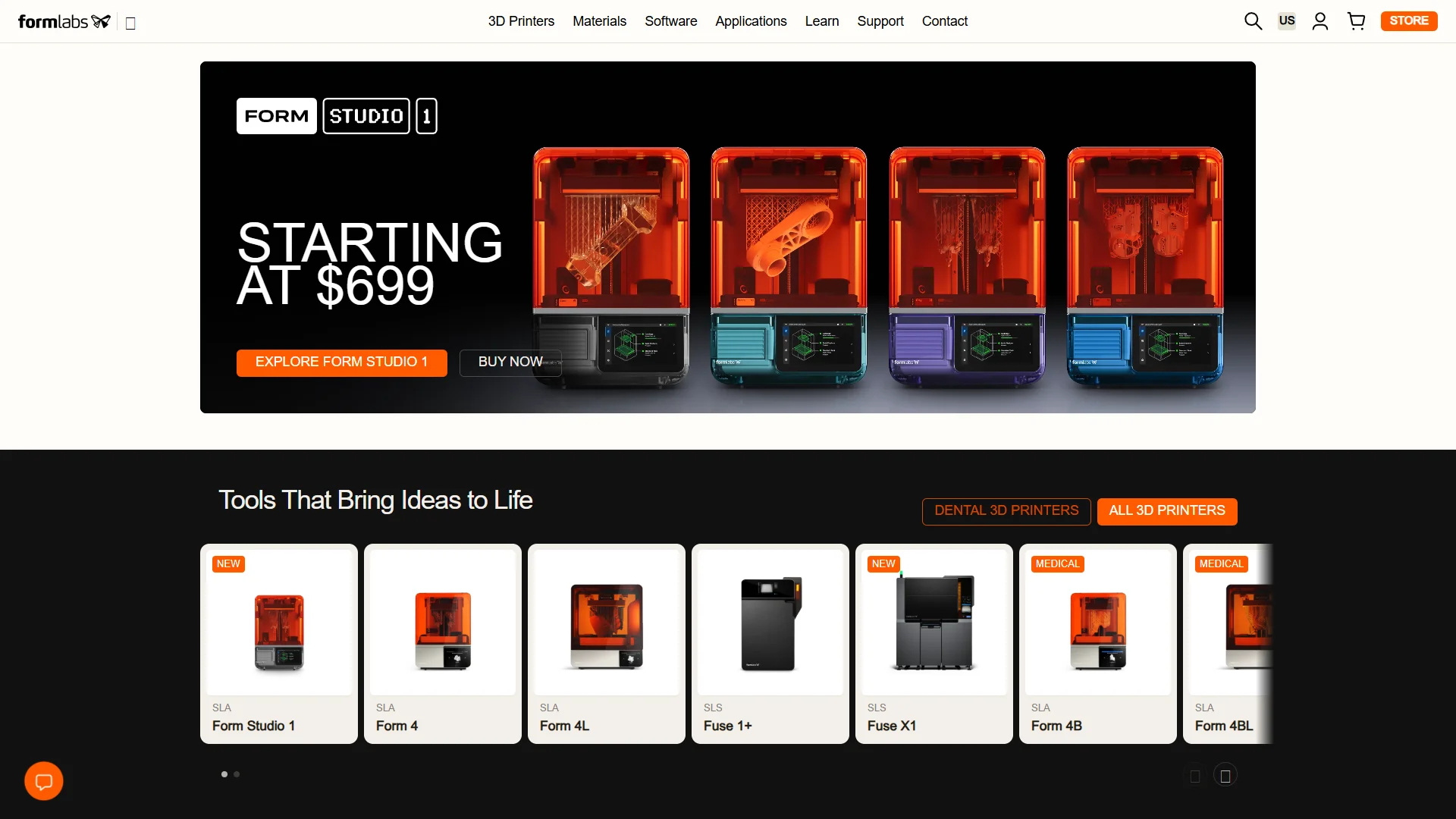
Overview: Formlabs presents a portfolio centered on professional 3D printing and materials, with stated applications spanning high-fidelity prototyping, industrial thermoplastic parts, dental manufacturing, medical models, and devices. The research specifically references SLS systems including the Fuse 1+ 30W, as well as high-throughput dental manufacturing and Open Material Mode.
Pros / Key Features:
- Offers industry-focused materials and an Open Material Mode, according to the supplied record.
- Supports SLS printing for industrial thermoplastic parts.
- Addresses high-throughput dental manufacturing for laboratories and aligner manufacturers.
- Targets high-fidelity prototypes intended to resemble final products.
- Research materials reference biocompatible models and medical device production.
Use Cases / Best For: Formlabs is suited to product-development teams, dental laboratories, medical-model users, and manufacturers that need professional desktop or production-oriented workflows. Its SLS capabilities are relevant to functional thermoplastic parts, while its dental and biocompatible offerings require careful review of the applicable material and regulatory documentation.
8. Markforged
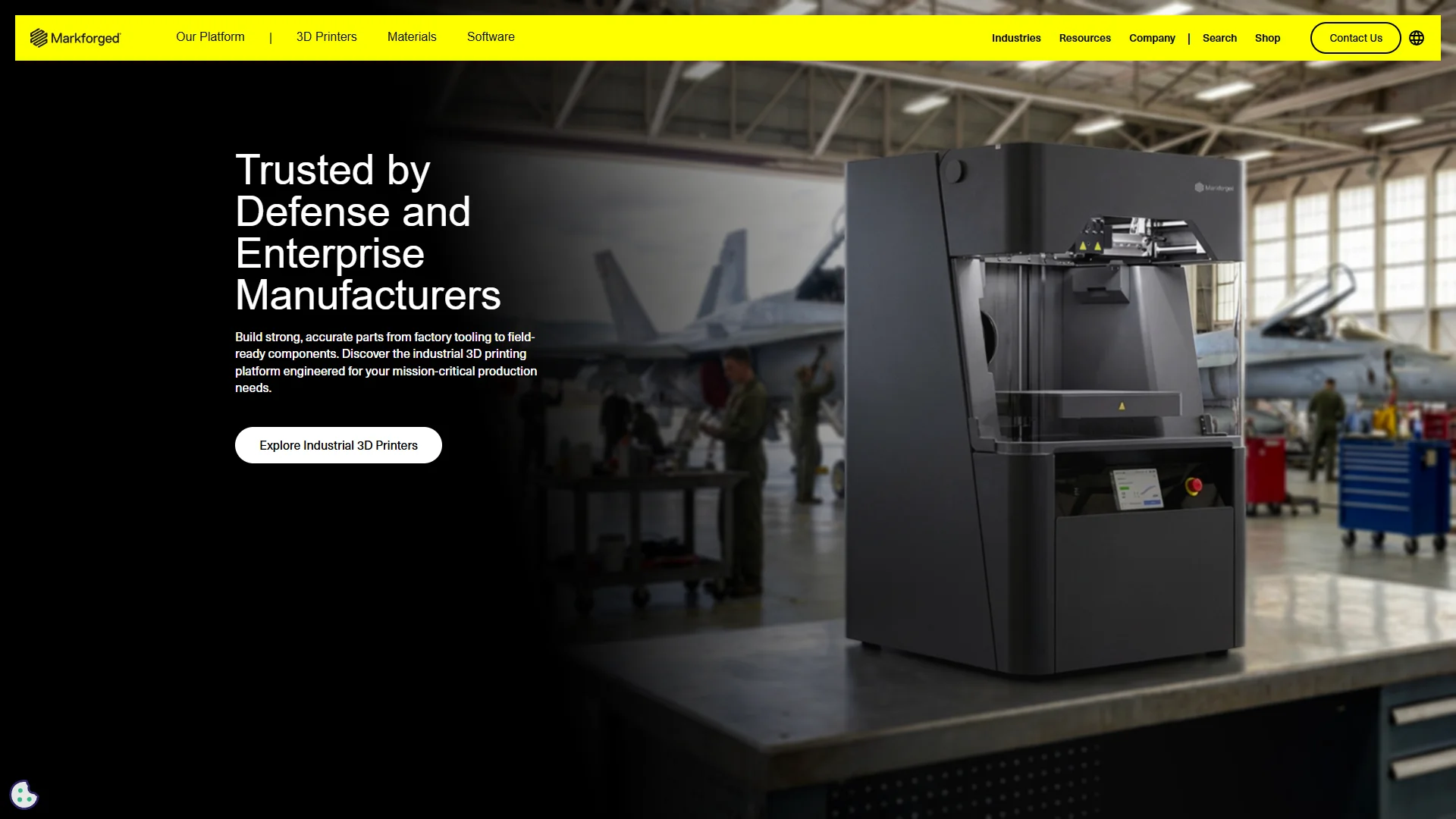
Overview: Markforged is included in the supplied roster as a 3D printing brand. However, the supplied structured research record does not clearly identify its products, materials, target markets, business model, certifications, service capabilities, or manufacturing specialties. For that reason, a detailed comparison should not infer specific machine or material claims without checking current official documentation.
Pros / Key Features:
- Recognized in the supplied roster as a participant in the 3D printing market.
- Requires direct review of current official product pages for verified technical specifications.
- Should be assessed against application requirements rather than assumed to match a particular process or material class.
Use Cases / Best For: Markforged is best considered by buyers willing to perform additional technical due diligence. Before selecting it, teams should confirm printer technology, compatible materials, build volume, tolerances, software workflow, service coverage, warranty terms, and any certifications relevant to the intended application.
How to Choose Among 3D Printing Manufacturers
Start with the organization type. Determine whether the requirement is for a printer, material, contract manufacturing service, distributor, or industry event. TCT Asia and 深圳3D打印展览会_深圳国际3D打印、增材制造及精密成型展览会_FormnextAsiaShenzhen serve discovery and industry-networking purposes, while RapidMade and Protolabs focus more directly on custom production services. 3D Printers Depot is primarily an online supplier.
Match the process to the part. Resin-based processes can support fine detail, while FDM, SLS, and metal systems address different combinations of strength, geometry, surface finish, temperature resistance, and production economics. Confirm the process used for the actual part rather than relying on a general company label.
Review materials and qualification evidence. Check technical data sheets, mechanical properties, chemical resistance, biocompatibility, ESD performance, flammability ratings, and any industry approvals required by the project.
Evaluate production readiness. For end-use parts, ask about repeatability, inspection, tolerances, post-processing, batch control, traceability, quality systems, and scale-up support. Certifications such as ISO 9001, ISO 13485, AS9100, or ITAR-related status may be relevant, but their applicability should be verified for the specific facility and service.
Compare the complete cost. Include software, materials, setup, labor, finishing, shipping, maintenance, service plans, tooling, and post-processing. A lower equipment price may not produce the lowest total cost of ownership.
Confirm support and lead time. Ask about engineering assistance, design-for-additive guidance, quote response, production capacity, replacement parts, training, warranty coverage, and expected delivery schedules.
Final Verdict
TCT Asia ranks first because it offers a broad industry-oriented route into additive manufacturing discovery and supplier comparison, although it should not be confused with a direct production manufacturer. RapidMade is a practical option for custom prototypes, small-batch parts, engineering support, and multiple polymer and metal processes. Protolabs is relevant to digitally quoted custom manufacturing and projects moving from prototyping toward production. 3D Systems offers a broad ecosystem of printers, software, manufacturing applications, service, and training, while Formlabs is notable for professional prototyping, SLS, dental, and medical-oriented workflows.
3D Printers Depot is more appropriate for online equipment and supply procurement. The two exhibition-focused entries are useful for market discovery and networking rather than direct part ordering. Markforged remains a brand that requires additional direct verification based on the limited supplied research record. The most suitable choice depends on whether the priority is industry intelligence, machine ownership, material capability, engineering support, or outsourced part production.
FAQs
Are all eight entries direct 3D printing manufacturers?
No. The roster includes manufacturers and production-service providers, as well as an online supplier and exhibition-focused organizations. Their roles should be distinguished before comparing prices or capabilities.
Which options are most relevant for custom manufactured parts?
RapidMade and Protolabs have the clearest supplied evidence for custom prototyping, production services, engineering support, and material or process selection. 3D Systems and Formlabs may also be relevant when the buyer is evaluating an in-house production ecosystem or specific application workflows.
What should buyers verify before placing an order?
Verify the exact process, material, tolerances, surface finish, build or part size, inspection method, certifications, lead time, post-processing, warranty, support, and total delivered cost. Requirements should be confirmed directly with the selected organization because capabilities can vary by facility, product, and application.
