


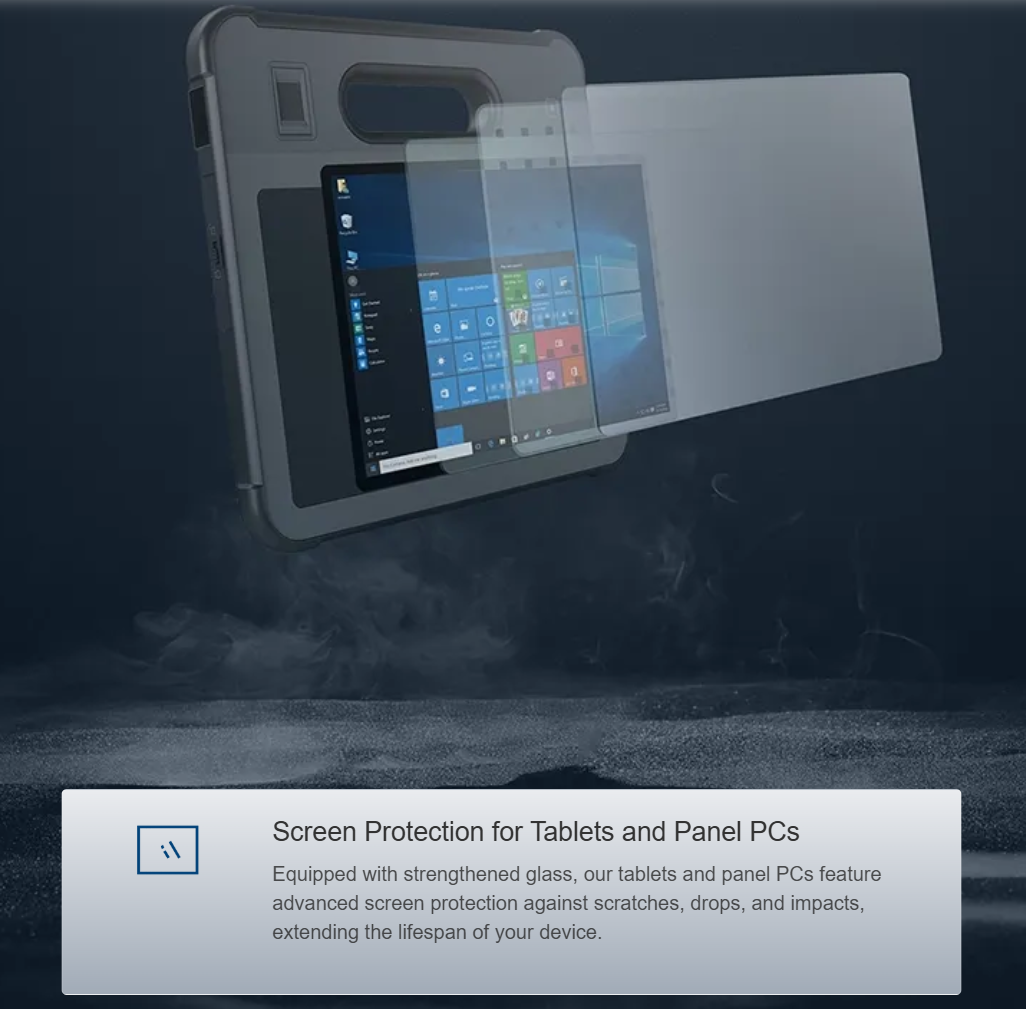
Problem: consumer tablets die where industrial ones survive
Most failures aren’t software. They’re heat. Consumer-grade terminals assume air, thin cases, and short duty cycles. Drop them into a sunlit loading bay or next to a bakery oven and the screen dims, touch lags, and apps throttle. That’s why many businesses move to purpose-built kit like a 10.1 tablet pc — sealed, bright, and made to stay sane under strain.
What’s actually cooking inside these displays
Optically bonded LCDs plus a 1000‑nit backlight look great outdoors. But “great” costs power. More LED current means more heat at the panel and the driver ICs. In sealed housings rated IP66 (per IEC 60529) there’s almost no convective cooling. So heat builds, the touch controller warms, and the system invokes thermal throttling to protect itself. The result: lag, dimming, and shortened component life.
Why optical bonding and high brightness are a double-edged sword
Optical bonding removes the air gap between glass and LCD to improve contrast and reduce reflections — ideal for sunlight readability. But that solid stack also reduces heat escape. Combine that with a high-power backlight (1000‑nit targets) and a waterproof chassis, and you’ve got trapped thermal energy. Add dust‑ and water‑blocking seals and you kill airflow entirely. Real-world anchor: IP66 means protection against strong water jets and dust ingress, so designers can’t rely on vents for cooling like consumer gear does.
Engineering fixes that actually work
There’s no mystery fix. Successful rugged tablets use a mix of passive thermal design and smart electronics: thicker metal chassis as a heat spreader, thermally conductive pads between PCB and frame, and heat pipes or graphite sheets to move energy away from hotspots. Low‑power LED driving and adaptive backlight control cut peak loads. Also move heat-sensitive chips (like the touch controller) away from the backlight — placement matters. EMI shielding and conformal coatings protect reliability without opening the box. These moves keep the display at safe temps without noisy fans.
Deployment tips and realistic alternatives
Match the device to the job. If you need continuous outdoor use in deserts or kitchens, insist on a sunlight‑readable, optically bonded unit that lists thermal dissipation numbers and IP testing. If you can’t get that, consider an air‑conditioned enclosure, scheduled downtime for heavy tasks, or an external screen with its own cooling. For teams that prefer a tablet form factor, a certified 10.1 inch tablet built to handle 1000‑nit brightness and IP66 sealing is the practical route — it avoids the constant failure loop consumer tablets fall into.
Common mistakes teams make
Clients often pick models by spec sheet brightness alone. That’s a trap. Brightness without thermal design equals a ticking clock. Others ignore ambient load: a 1000‑nit screen indoors still generates heat and will stress components over long shifts. And firmware-only fixes — throttling aggressively — degrade user experience. You need hardware and software that cooperate.
Advisory: 3 golden rules to choose right
1) Thermal capacity over peak brightness: ask for thermal dissipation or thermal resistance (°C/W) data. A backlight rated for 1000 nits should ship with a chassis and heat spreader that sink that power.
2) Proven IP and thermal testing: require IEC 60529 IP ratings and thermal cycle reports showing sustained operation at target ambient temps. IP66 without thermal testing is not enough.
3) Component layout and serviceability: confirm heat sources are separated (backlight vs. CPU vs. touch controller) and that the design allows repairs or part swaps without breaking seals. This saves uptime and total cost.
Choosing a rugged device isn’t guesswork — it’s engineering. For practical deployments, you want a vendor that publishes specs, shows test data, and designs with thermal paths in mind — that’s the real value Estone provides.
