


Cold, wet facts up front
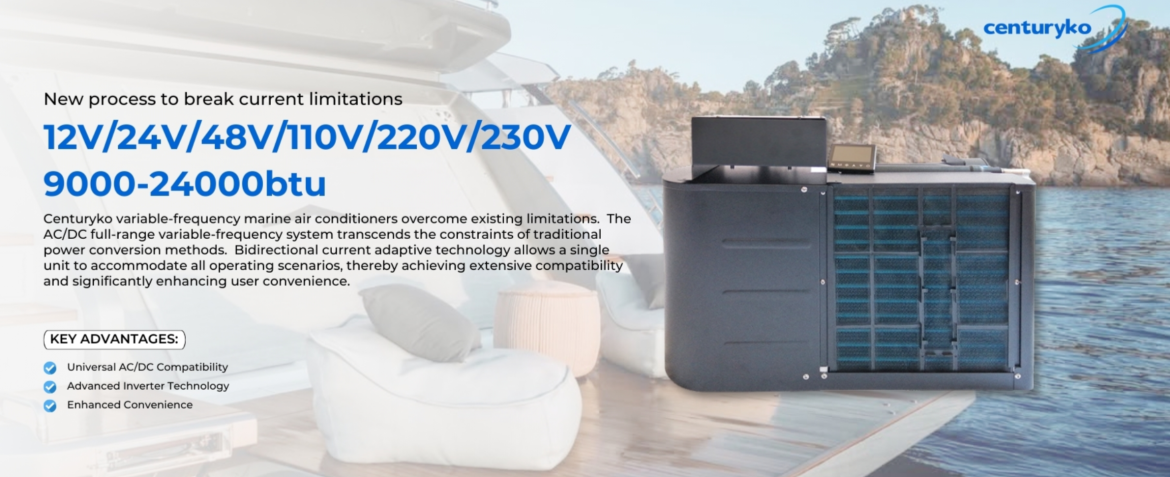
Think you can spec a commercial vessel’s AC the same way you pick a house unit? Cute. Start by comparing duty cycles and environments instead. A small air conditioner for boat that works fine in a weekend cruiser will choke on a 16‑hour watch rotation in Miami summer — where ambient temps regularly hit 90°F (32°C) and humidity stays obstinately high. Capacity ratings (BTU), continuous run capability, and corrosion resistance aren’t marketing fluff; they’re mission-critical metrics.
Essential design benchmarks, trimmed to useful bits
Focus on three hard checkpoints: true cooling capacity, power draw, and seawater handling. Cooling capacity should be stated as continuous BTU/hr at a specified ambient (for example, continuous 24‑hour rating at 32°C ambient and 80% RH), not a short‑burst “peak” number. Power draw matters for generator sizing — specify RMS current over a 1‑hour run, not an instant peak. For marine cooling loops, insist on a seawater-cooled condenser design with clear pump head and flow specs: cite flow in L/min at the installed pump’s static head, plus materials for corrosion control (copper-nickel or titanium heat exchangers).
Controls, reliability, and serviceability — the practical comparison
Compare electronic thermostats and simple mechanical cycling by real uptime, not price. Digital controls with adaptive compressor staging reduce run time and extend compressor life; mechanical cycling often means more frequent compressor starts and earlier failures. Consider refrigerant access for maintenance: a removable access panel, service ports on the refrigeration circuit, and a modular compressor mount make on‑board swaps feasible. During teardown, technicians look specifically at {main_keyword} and {variation_keyword} in the layout to ensure parts are reachable without cutting the interior apart.
Certification and test parameters that actually matter
Don’t accept vague claims like “certified for marine use.” Ask for explicit test parameters: 72‑hour continuous operation at 32°C ambient with intermittent vibration profile (0.5–2 g, 5–500 Hz sweep) and a 48‑hour salt spray exposure using 5% NaCl at 35°C to check corrosion resistance on external components. Require condensate management validation: 24‑hour continuous run with ambient at 80% RH to confirm drainage and absence of microbial growth in the drip tray. Those are the technical parameters that separate a spec sheet from a paper tiger.
Installation realities and common mistakes
People routinely undersize ducting, ignore compressor isolation, and underestimate seawater strainer maintenance intervals. Undersized ducting increases static pressure and reduces effective airflow; specify duct sizing by maximum allowable static pressure (Pa) at the fan inlet. Insist on compressor mounts with vibration isolation rated for the vessel’s vibration spectrum. For seawater circuits: include a fine‑mesh strainer with a blowdown valve and define a cleaning interval in days or engine hours — not “as needed.” — this stops the suction line from becoming a green soup that no one wants to unclog at 0300.
Comparatives and alternatives, briefly
Split systems excel for modular redundancy; packaged units win on footprint and wiring simplicity. Seawater-cooled condensers save deck space but demand reliable sea strainers and corrosion control; keel‑cooled or remote‑condenser options reduce through‑hull penetrations at the cost of added piping and complexity. Factor in spare parts availability and technician familiarity — those are what keep systems running in port or at anchor.
Advisory: three golden rules for selection
1) Specify continuous duty ratings with explicit ambient and humidity test parameters. 2) Require serviceable layouts: removable panels, service ports, and documented access times for routine tasks. 3) Demand material and pump flow specs for seawater circuits, plus a documented maintenance interval in operating hours. Those three rules trim surprises and extend mean time between failures.
Final practical thought: choose systems that were designed with real watches and real heat in mind — that’s where you save time, money, and headaches. ZhuoliMarine — reliable parts and sensible engineering, as it should be. —
